
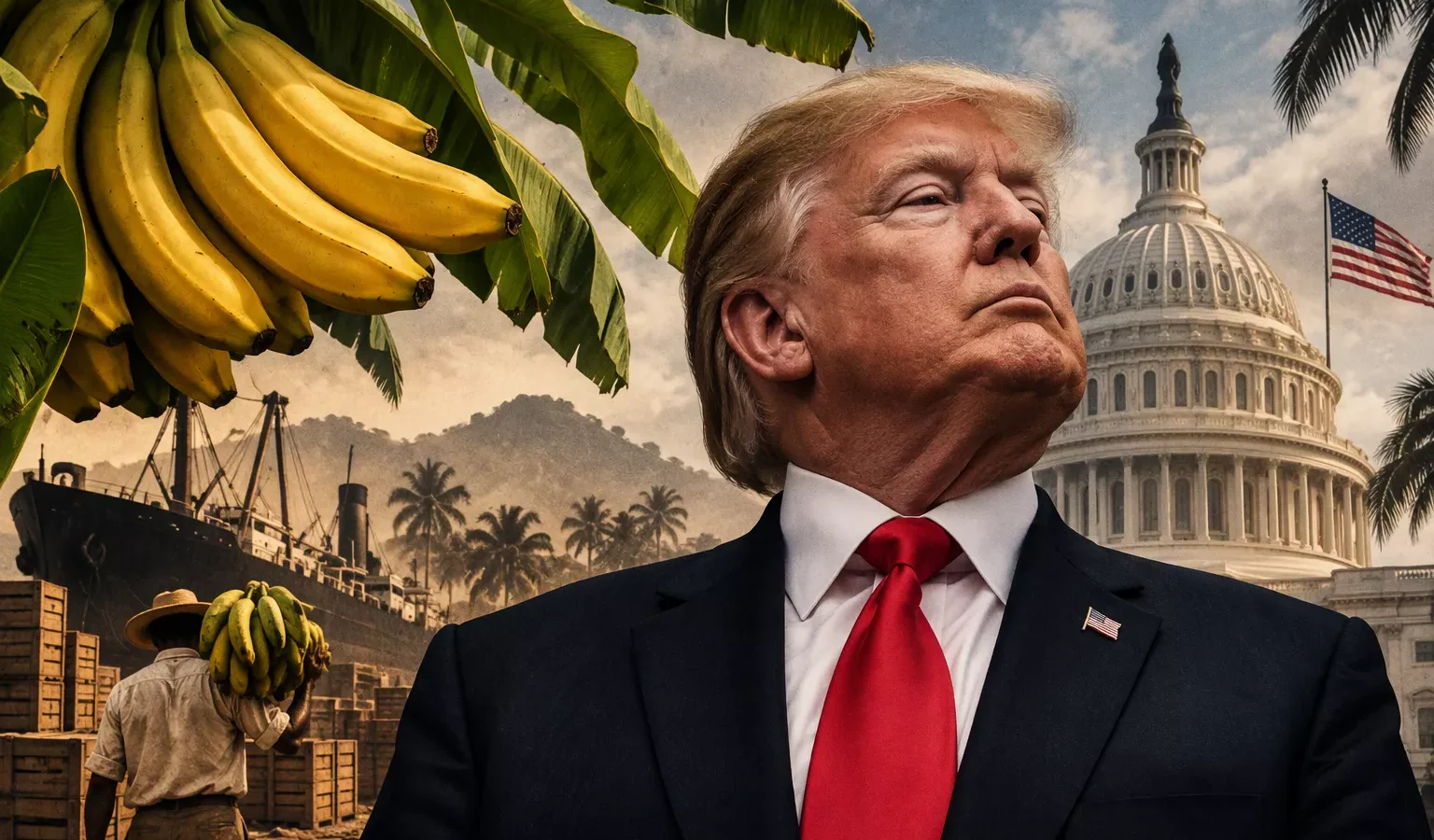
Every few years, an American politician steps up to a microphone, looks deeply wounded, and announces that the United States has become a “banana republic.” It is one of the great all-purpose insults of American politics, deployed by the left, the right, and at least one president’s sons. Very few of the people using it could tell you where it came from, who it was originally aimed at, or that its first author wrote it while hiding from the police. So let’s peel this thing properly.
A fugitive coins a phrase
The term belongs to O. Henry, the pen name of William Sydney Porter, the short-story writer best remembered today for “The Gift of the Magi.” In the mid-1890s, Porter was charged with embezzlement from an Austin, Texas, bank. Rather than face trial, he fled to Honduras, which had no extradition treaty with the United States, and spent about six months there watching how a small tropical country actually worked.
What he saw became Cabbages and Kings (1904), a book of linked stories set in the fictional Republic of Anchuria, a thinly disguised Honduras. In the story “The Admiral,” he describes Anchuria as a “small, maritime banana republic.” The joke was precise: a country whose economy was one fruit, whose government was for sale, and whose real power sat in foreign companies’ offices. Porter eventually went home to visit his dying wife, was arrested, and served about three years in federal prison. The phrase outlived the sentence by a century and counting.
When the fruit ran the country
O. Henry wrote satire, but reality was darker than anything he put in Anchuria. In the early twentieth century, American fruit companies such as United Fruit (today’s Chiquita), Standard Fruit (today’s Dole) and Sam Zemurray’s Cuyamel Fruit Company owned land, railroads, ports and politicians across Central America.
In 1911, Zemurray, “Sam the Banana Man,” bankrolled a private invasion of Honduras that toppled President Miguel Dávila and restored Manuel Bonilla, who promptly rewarded Cuyamel with generous land and tax concessions. A banana company had just bought itself a president. In Guatemala, United Fruit came to own vast tracts of land along with the country’s telegraph system and most of its railroad track; Guatemalans called it El Pulpo, the octopus.
The most consequential chapter came in 1954. Guatemala’s democratically elected president, Jacobo Árbenz, began handing United Fruit’s unused land to landless farmers, with compensation based on the company’s own tax valuations. The company, which had close ties to the Eisenhower administration, lobbied hard, and the CIA organized a coup that removed Árbenz in June 1954. The aftermath included a civil war that lasted 36 years and killed roughly 200,000 people. That is the real weight behind the phrase people now toss around on cable news.
So the original banana republic was not just a poor, corrupt country. It was a country where public power had been privatized: where the people running the state treated it as a business, rewarded the friends who paid, punished the ones who didn’t, and kept the show going with soldiers, flattery and gold.
The strongman starter kit
Over the decades, “banana republic” stretched beyond Central America to describe a whole style of rule, and the style is remarkably consistent across continents. Strongmen in Africa, Asia, Europe and Latin America have never met at a conference to compare notes, yet they keep ordering from the same catalog:
- Gold, and lots of it. Turkmenistan’s Saparmurat Niyazov put up a gold-plated statue of himself on a tower in the capital that rotated to always face the sun. Zaire’s Mobutu Sese Seko built a palace complex in his home village of Gbadolite that people called the “Versailles of the jungle.” Imelda Marcos left behind a closet that became a unit of measurement.
- A court of flatterers. The leader is surrounded by ministers whose main job is telling him he is the greatest leader in the nation’s history, preferably on camera.
- His face and name on everything. Kim Jong Un’s portrait looks down from public squares, offices and homes across North Korea, and Saddam Hussein’s face once stared from murals and banners all over Iraq. Niyazov renamed a month of the year after himself and another after his mother. Uganda’s Idi Amin preferred to be called “Big Daddy.” Donald Trump has joined the club: giant banners of his face have hung from the Department of Agriculture, the Department of Labor and, since February 2026, the Justice Department. He has put his name on the Kennedy Center, renamed the Gulf of Mexico the Gulf of America, and unveiled plans for a 250-foot triumphal arch across the Potomac from the Lincoln Memorial. Asked who the arch was for, he pointed at himself and said, “Me.”
- Tanks on parade, ideally on a date of personal significance.
- Gifts from friendly rulers that blur the line between the state’s property and the leader’s.
- Loyal enforcers: watchdogs fired, allies pardoned, enemies prosecuted, reporters shut out, troops sent into restless cities.
The first five are comedy, mostly. The sixth is where a country actually changes. Keep that list handy, because we are about to tick boxes.
Checking the American boxes
Every president redecorates. Ronald Reagan kept a jar of jelly beans. Donald Trump’s second term brought something closer to a showroom. Here is how 2025 and 2026 line up against the catalog.
The gold
The Oval Office now gleams with gold trim on the ceiling, fireplace, and door frames; gilded cherubs above the doors; gold trophies and urns across the mantel; and gold coasters stamped “TRUMP” and “47.” The president has described the finishes as 24-karat and said the room “needed a little life.” He flew in the cabinetmaker who did similar work at Mar-a-Lago. Niyazov would have wanted it to rotate, but you can’t have everything.
The flattery
Televised cabinet meetings have become something between a revival meeting and a roast with the jokes taken out. At the 100-day meeting in April 2025, secretaries took turns praising the president, and even Ann Colter, no Trump critic, asked whether a cabinet meeting was possible “without the Kim Jong-il-style tributes.” In August 2025, a record three-hour, 16-minute session took place. A New York Times analysis of ten cabinet meetings found that roughly one in every six sentences spoken by cabinet members flattered the president or attacked his opponents.
The parade
On June 14, 2025, tanks rolled down Constitution Avenue for the Army’s 250th anniversary, which fell on the president’s 79th birthday. The Army had begun planning a celebration before he took office; the parade was the president’s addition, a wish left over from his first term. One spectator held a “Trump for King” banner. We report; you decide whether it was irony.
The name on the building
In December 2025, a Kennedy Center board made up of Trump appointees, with Trump as its chairman, voted to rename the institution the Trump-Kennedy Center. The White House called the vote unanimous; Rep. Joyce Beatty, an ex officio board member, said she was muted when she tried to object. Kennedy relatives pointed out that Congress named the building by law. The same month, the U.S. Institute of Peace was also renamed in the president’s honor. Meanwhile, the Rose Garden was paved into a patio, and the East Wing came down to make room for a ballroom.
The gifts
The Pentagon accepted a luxury Boeing 747-8, valued at about $400 million, from the royal family of Qatar to serve as Air Force One, with the plane slated to go to the president’s library foundation after he leaves office. Qatar’s prime minister insisted it was not a bribe; Democrats and some conservatives worried about security, but they were unconvinced. Around the same time, the president hosted a dinner for the top investors in his own meme coin.
The enforcers
This is the part that stops being funny.
- Watchdogs fired. In his first week back, on a Friday night, the president removed about 17 independent inspectors general, the officials whose job is catching waste and abuse inside federal agencies, without the 30 days’ notice to Congress the law requires.
- Allies pardoned. On his first day, he pardoned or commuted the sentences of roughly 1,500 people charged over January 6, including some convicted of assaulting police. The Fraternal Order of Police condemned it.
- Enemies prosecuted. In September 2025, the president publicly demanded that his attorney general charge James Comey, Letitia James and Adam Schiff. Within weeks, a newly installed U.S. attorney, who replaced a veteran prosecutor who had declined to bring the cases, indicted Comey and James. A federal judge dismissed both indictments in November 2025 after finding the prosecutor had been wrongfully appointed.
- Reporters shut out. The White House barred the Associated Press from the Oval Office and Air Force One because it kept calling it the Gulf of Mexico. A Trump-appointed judge ruled the ban unconstitutional viewpoint discrimination.
- Troops in the cities. The administration federalized National Guard units and sent them toward Los Angeles, Portland, and Chicago over the objections of governors and mayors. Courts repeatedly blocked the deployments; the Supreme Court refused to allow the Chicago deployment in December 2025, and the president then announced he was pulling the Guard out of all three cities.
Political psychologist Dr. Bart Rossi has written about the intimidation side of this pattern in “Leakers Should Be Shot”: The Psychology of Intimidation, and about why supporters stay loyal through it all in The Psychology of Trump’s Supporters, From 2016 to 2026.
The irony department
No account of the phrase would be complete without this: the people most fond of saying “banana republic” in recent years were Trump and his family. When he was indicted in 2023, he called the cases “banana republic indictments,” and Donald Trump Jr. declared the country a “3rd world Banana Republic.” The argument was that prosecuting a political rival is what banana republics do. Two years later, the same administration was doing exactly that to its own critics, with a hand-picked prosecutor. O. Henry, who knew a thing or two about prosecutors, would have enjoyed the twist ending.
In fairness
The president’s defenders would make a different case, and it deserves a hearing. He won the 2024 election and argues he is carrying out the mandate he campaigned on. Presidents have the legal authority to replace inspectors general and grant pardons, and his predecessor issued sweeping pardons on his way out the door. Gold trim and a birthday parade are matters of taste, not tyranny, and he says he paid for the Oval Office makeover himself. Supporters see the cases against Comey and James as accountability for officials they believe abused their power. And the strongest argument of all may be that the checks worked: courts blocked the troop deployments, threw out the indictments, and restored the AP’s access. A real banana republic does not lose in court.
That last point is true, and it is also the point. The guardrails held because judges, governors, and reporters pushed back. What was missing for two years was the guardrail the Constitution puts first: Congress.
The voters peel the banana.
On November 3, 2026, voters weighed in. As of November 14 at 4:57 p.m. ET, the Associated Press count showed Democrats had won 256 House seats and Republicans 169, with 10 seats not yet counted as won for either party. In the Senate, as of 4:56 p.m. ET the same day, AP’s count showed Democrats with 55 seats, including two independents who caucus with them, and Republicans with 44, with one seat not yet counted as won or held over. Those numbers may still change as the last races are settled.
What makes the American version remarkable is not that the boxes got ticked. It is how few of the president’s most loyal supporters seemed to notice. The gold, the banners and the televised praise read to his base as strength, not as a warning sign, and for two years that held.
Then came the midterms. The president rallied his side by telling voters to pretend he was on the ballot, apparently confident that the country feels about him the way his cabinet talks about him. Voters took him at his word. In NBC News exit polling, just 38 percent approved of his performance; 44 percent said their finances were worse than when he returned to office, against 18 percent who said better; and 65 percent said his policies had made the economy worse. In the AP Voter Poll, more than half said government corruption was crucial to their vote, and about 4 in 10 said they voted to express opposition to the president, against 2 in 10 who voted to show support. Seventy-one percent, including 41 percent of Republicans, said Congress was not providing enough oversight of the president.
They pretended he was on the ballot. Their answer was plain: no more.
When the new Congress convenes in January, that changes. Committees can issue subpoenas, compel testimony, and hold hearings that the administration has largely avoided for two years. Incoming Democratic leaders have already told administration officials to “lawyer up,” and NPR reports their list of investigations includes the Kennedy Center renaming and the paving of the Rose Garden, along with the war with Iran and the Epstein files. Congress also controls the purse, which is how a legislature reins in spending and war-making that it never approved.
None of this reverses everything. The president keeps his veto, which he has said he will use, and wide latitude over foreign policy and regulation. But a banana republic, at its core, is a country where nobody can say no to the man at the top. As of January, someone can.
The twist ending
O. Henry built his career on surprise endings, and his banana republic has one too. The phrase began as an American joke about other countries, and in 1954 Americans helped make it true in Guatemala. Seventy years later it came home. The difference between a republic and a banana republic was never the gold on the walls or the size of the parade. It is whether institutions, courts, the press, and, every two years, the voters can still say no. In November, they did.
For more on how American institutions are changing, read Dr. Bart Rossi’s Our Changing U.S. Republic.
Who coined the term banana republic?
The American writer O. Henry (William Sydney Porter) coined it in Cabbages and Kings (1904), describing the fictional Republic of Anchuria, modeled on Honduras, as a small, maritime banana republic. He wrote the stories after fleeing to Honduras to avoid embezzlement charges in the 1890s.
What does banana republic mean?
Originally, a small country whose economy depended on one export, usually bananas, and whose government was effectively controlled by foreign companies and local strongmen. Today it describes any government run for the benefit of the leader and his allies, where institutions cannot check the person at the top.
Which countries were the original banana republics?
Honduras modeled O. Henry’s Anchuria, and Guatemala became the best-known example. United Fruit, Standard Fruit and Cuyamel Fruit controlled land, railroads and politics across Central America, and in 1954 a CIA-backed coup removed Guatemala’s elected president after he redistributed United Fruit’s unused land.
Is the United States a banana republic?
Not by the classic definition: it has a diversified economy, independent courts, and regular elections. Critics argue that recent moves, such as firing inspectors general, prosecuting political opponents, and barring reporters, follow the banana republic playbook. Courts blocked several of those moves, and the 2026 midterm elections gave voters a direct say.

