People have often been puzzled about how “Christians” can support Donald Trump, when he is clearly un-Christian, based on his words and deeds. It is the most-asked question in American religion for a decade running, and it usually gets one of two lazy answers: either the believers are hypocrites, or the critics don’t understand faith. Neither explains much. So let’s take it apart properly: what he has actually said and done, how a movement built on “values” learned to look past it, and what finally started to give in 2026.
The record, in his own words
Start with the basics of the faith. Christianity turns on repentance and forgiveness. In July 2015, at the Family Leadership Summit in Iowa, pollster Frank Luntz asked candidate Trump whether he had ever asked God for forgiveness. His answer: he wasn’t sure he ever had, and he didn’t “bring God into that picture.” He offered communion, his “little wine” and “little cracker,” as the closest thing.
Six months later, he quoted “Two Corinthians” at Liberty University. In June 2020, after protesters were cleared from Lafayette Square, he posed in front of St. John’s Church holding a Bible he did not open. In March 2024, he was selling a $59.99 “God Bless the USA” Bible, bundled with the Constitution and a Lee Greenwood chorus.
Then came the moment that should have settled the argument. At Charlie Kirk’s memorial in September 2025, Kirk’s widow, Erika, forgave the man accused of killing her husband, “because it was what Christ did.” The president spoke next. Kirk, he said, did not hate his opponents. “I hate my opponent, and I don’t want the best for them. I’m sorry.” The crowd laughed. Love your enemies, meet the man who doesn’t.
And in April 2026, in the middle of a public feud with Pope Leo XIV over the Iran war, he posted an AI-generated image of himself in a white robe, laying hands on a sick man, bathed in heavenly light. He said he thought it showed him as a doctor. Even some of his most loyal Christian allies called it blasphemy, and he took it down.
How believers squared it: the bargain
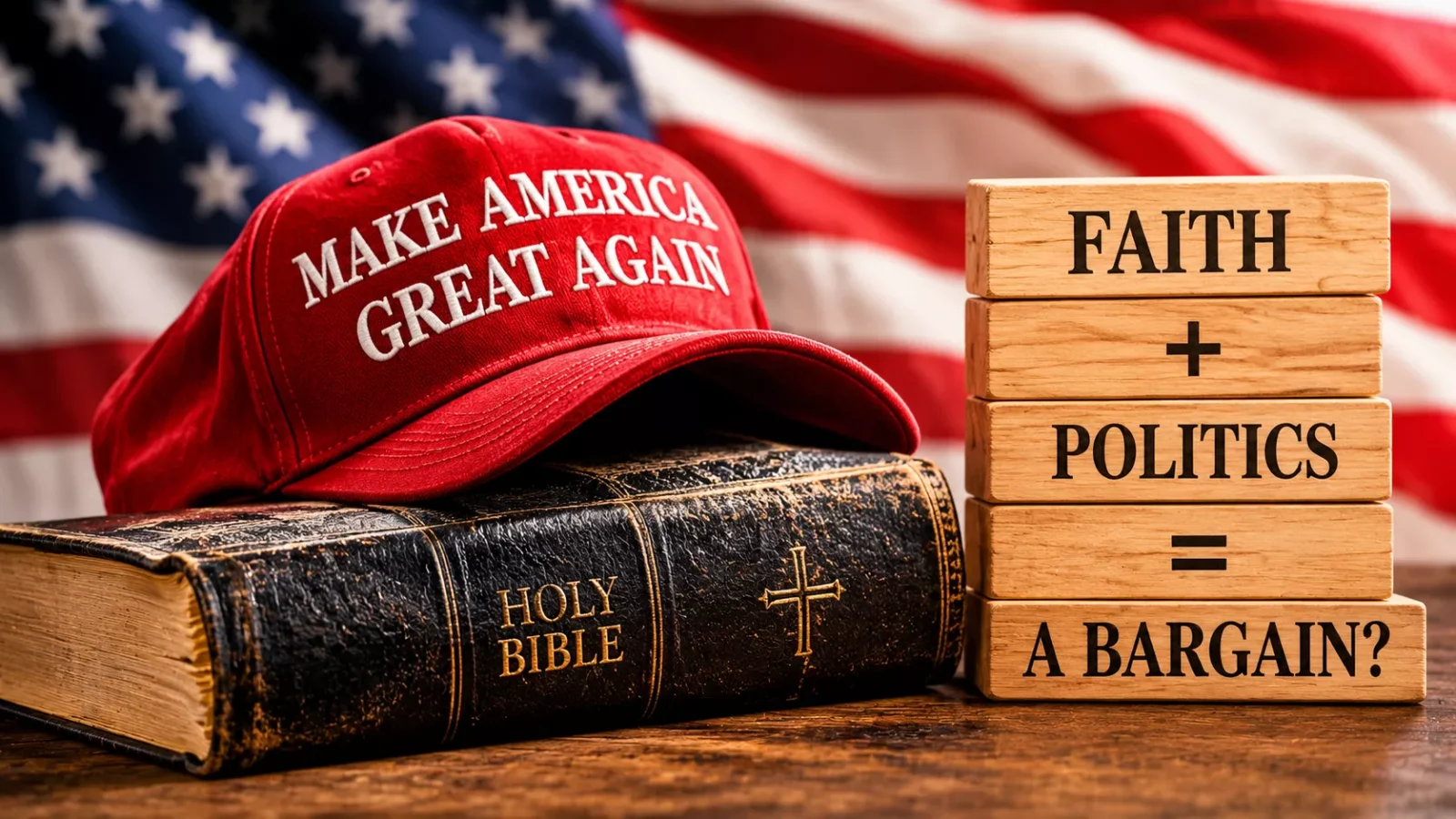
Here is the part critics tend to skip. Most evangelical voters never claimed Trump was a good Christian. They claimed he was useful. The religious right was built as a political project, from Jerry Falwell’s Moral Majority in 1979 onward, and its goals were concrete: judges, abortion law, school prayer, religious liberty. By 2016, the movement had spent forty years losing the culture war and was looking less for a deacon than for a bodyguard.
Trump offered a deal, and he kept much of it. Three Supreme Court justices. The end of Roe v. Wade in 2022. An open door at the White House. On those terms, the vote was a contract, and you don’t fire a contractor for his manners.
The prophets supplied the theology
A bargain explains the vote. It doesn’t explain the hands on his shoulders, the prayer circles in the Oval Office, or the conviction that he was sent. For that, a newer and louder strand of charismatic Christianity stepped in. In 2016, the self-described prophet Lance Wallnau published God’s Chaos Candidate, which popularized the idea that Trump was a modern King Cyrus, the pagan Persian king of Isaiah 45 whom God used to free the Jews from Babylon.
The Cyrus story did something clever. It took the president’s behavior off the moral scoreboard entirely. Cyrus was never supposed to be holy; he was supposed to be chosen. Once a leader is “anointed,” his sins stop counting against him, and anyone who criticizes him is no longer arguing with a politician. They are arguing with God.
Not all Christians signed the contract
It’s worth saying plainly: “Christians” were never one bloc. Black Protestants have voted overwhelmingly against Trump in every election. Catholics split, and in the 2026 midterms they moved from majority Republican to a near-even split. Mainline Protestants have steadily soured on him. The puzzle is really a puzzle about one group, white evangelicals, and even there, millions never bought in.
What 2026 changed
The bargain held through two impeachments, a felony conviction, and January 6. What it could not survive easily was a year in which the contract stopped paying out, and the symbolism turned sour at the same time: an unpopular war with Iran, gas prices to match, a public fight with the pope, and a president who appeared to cast himself as Christ.
Pew found his approval among white evangelicals fell from 78% at the start of his second term to 58% by October. On November 3, they didn’t switch sides; they stayed home. White evangelicals were 17% of midterm voters, down from 23% in 2024, while the ones who did vote still went Republican by about 82%.
Why they withdrew rather than defected is a question for a psychologist, and political psychologist Dr. Bart Rossi has taken it on directly in “Religion in America: Why the Faithful Stayed Home”, which walks through cognitive dissonance, the “imperfect vessel” story, and why disillusioned believers exit quietly instead of turning on their own.
The bottom line
So how can “Christians” support a man so plainly at odds with the faith? Mostly by not asking him to share it. They hired a fighter, and some of their preachers then baptized the hire. The arrangement worked as long as the fighter kept winning and stayed in his role. In 2026, he stopped doing both, and the pews noticed. The hands are still on his shoulders. Fewer of them are attached to voters.
Why do evangelical Christians support Donald Trump?
Most describe it as a bargain, not an endorsement of his character: conservative judges, the end of Roe v. Wade, religious-liberty protections and a fighter against a culture they feel is turning on them. A smaller movement of self-described prophets went further and called him anointed by God.
What is the King Cyrus argument?
Cyrus was the Persian king in Isaiah 45 who freed the Jews from exile without sharing their faith. Some evangelical leaders, most prominently Lance Wallnau in his 2016 book God’s Chaos Candidate, cast Trump as a modern Cyrus: an unbeliever God could still use.
Did evangelicals turn against Trump in the 2026 midterms?
Mostly they stayed home. White evangelicals fell to about 17% of midterm voters, down from 23% in 2024, while roughly 82% of those who did vote still backed Republicans.