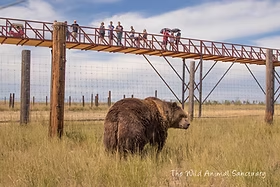
Wild Animal Sanctuary rescues lions, tigers, and bears. Oh my! More accurately, 43 African Lions, 14 Mountain Lions, 70 Tigers, 87 Bears, 28 Wolves, and many other species —all carnivorous except for a single porcupine and a camel —make up a total of 290 animals in the rescue.

The intolerance to a single Jaguar’s plight [that was locked in a small cage at the Denver Zoo] in 1981 stimulated Pat Craig’s sympathy. “They’re surplus animals,” he was told, “there is no room for them in the larger spaces.”
He was only nineteen, but that moment prompted him to act. He rescued that Jaguar (Freckles) by getting permits to keep the big cat on his mother’s farm. It was the catalyst for a life committed to rescuing abused and tormented animals: he created The Wildlife Animal Sanctuary thirty-one years ago and continues that lifelong commitment to animal rescue.
Today, The Wildlife Animal Sanctuary is the largest carnivorous wildlife sanctuary in the Western Hemisphere, occupying 720 acres in Keenesburg, Colorado; in addition to that,
they just received an additional 300 adjoining acres as a gift.
Twenty-plus years after they began rescuing animals, and only after management considered their ultimate safety and welfare, TWAS opened to the public in 2003.

In 2012, the Sanctuary opened its Mile Into The Wild, an elevated walkway that takes visitors from the base of the entrance [just beyond the gift shop], past the animal indoctrination center, and then along the expansive open areas where wolves, bears, tigers, and lions roam. It ends at the Bolivian Lion Complex (a closed-in heated facility, built on short notice to accommodate 25 lions rescued from Bolivia, South America). From inside the complex, the lions have outdoor access to three separate prides, each with 20 acres.
From the walkway, spectators have an unobstructed view, and the animals don’t perceive airspace as territory, making it a win-win scenario.
An area along the walkway is also set up with tables and chairs for those who want to stop and picnic; a snack bar is also located there.
An additional section was just completed that provides direct access from the far parking lot to the walkway, eliminating the need for visitors to utilize the shuttles from the overflow parking areas to the main entrance. A thirty-thousand square-foot welcome center is expected to be completed by the summer of 2013.

Did you know that tigers are the only cats that like water? I didn’t either. But my guide Katie provided an ongoing education and narrative as we progressed along the
walkway.
“Those bears there are Natasha and Tiny. Aren’t they cute together? They’re boyfriend and girlfriend. Our motto is OK to dating, no no to mating.” She went on to explain that even though they strive to stimulate the animals’ natural wild instincts — such as feeding the tigers three times a week to stay within the feeding schedule of a tiger found in the wild —it would be cruel for the offspring to be born into captivity.
“Some of these animals were so badly abused that they have no idea what the wild is. For example, we’ve had big cats that — before they arrived here — had never seen or touched grass: they were in cages in someone’s basement all their lives.”
“That camel? He is a different story altogether. He was raised on a horse farm and thinks he’s a horse,” she said. “When the farm was sold, and the stables were to be shut down, the owners of the horses — that were boarded there — were so concerned for the camel that they all pitched in to cover the cost to have him transported here so that he wouldn’t be destroyed. Being non-carnivorous, he was certainly an exception to our standard guests here. He’s the only camel we will likely ever have, and he seems content, so we just let him think he’s a horse.”
Katie’s connection to these animals—like all the staffers and volunteers I saw—was apparent. She knew all the animals’ names, and recited stories about each of them. When she was 10 years old, she saw a documentary about Pat Craig (founder-executive
director) and his Sanctuary, and after graduating from college, she headed west from Georgia, intent on working at TWAS; she is now the communications director.

TWAS offers no guided tours; visitors are on their own because of the small staff. But they are building audio boxes where a spectator can press a button and hear a fact-filled audio of what they are seeing – and what they should be looking for – at that place along the walkway.
In addition to Katie, the staff includes fifteen people and a dedicated volunteer team of one hundred. She noted that “We could never run this place without the volunteers; they’re so amazing!”
Dug into the ground beneath the vast open space that the packs and prides enjoy are dens. “Do you see those round cement cylinders there? Those are tunnels that go into the ground about ten feet, and then open up to areas as large as 30 x 50 feet; the bears hibernate in there.”
While TWAS cares for nearly 300 animals, it is also the only sanctuary or zoo in the U.S. that maintains a full fleet of specialty air-conditioned animal transport vehicles. It uses them to rescue animals regularly — throughout the U.S, Canada and Mexico. It also occasionally works with others to support the rescue of animals for other facilities.
For example, in 2011 TWAS worked with USDA, IFAW (International Fund for Animal Welfare) and the Global Federation of Animal Sanctuaries to provide the vehicles to relocate twelve tigers — that would have otherwise been lost — to various facilities around the U.S.
Wandering this sanctuary, you can’t help but feel humbled by the magnificence of these animals and the care and effort so many provide. It’s a reminder of the ripple effect that one person’s passion can create. In this case, it began with a 19-year-old boy.
I highly recommend a trip out to The Wild Animal Sanctuary. You’ll enjoy the day, be amazed by the sights, and help support a wonderful cause.
The Wild Animal Sanctuary
1946 County Road 53
Keenesburg, CO 80643
303-536-0118
Wildlife Rescue
For more information,
virtual tour, their newsletter, and more, visit their website at https://www.wildanimalsanctuary.org/